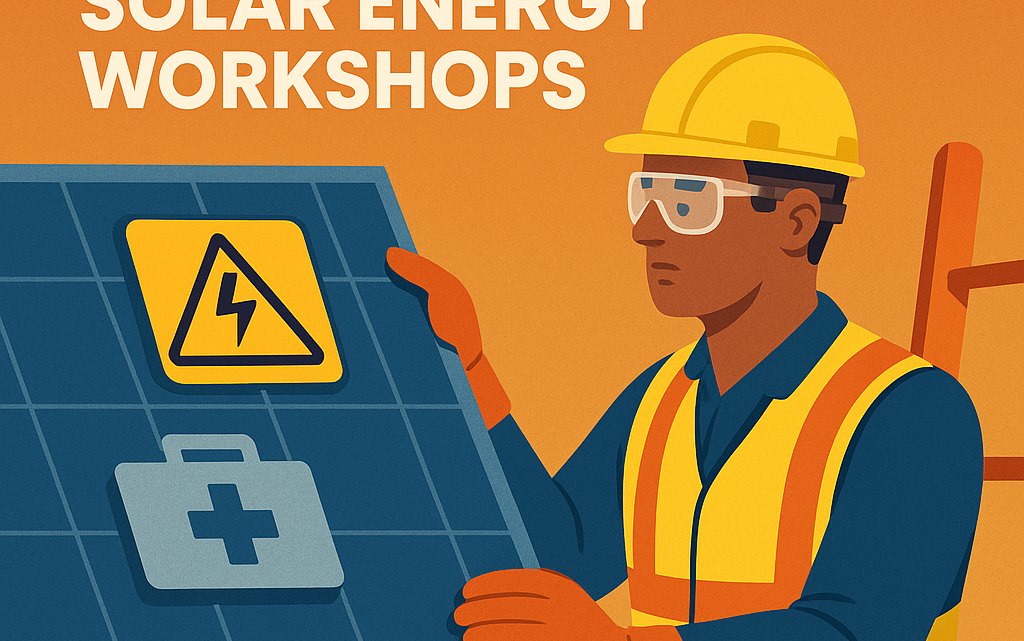
Safety First: Building a Strong Safety Culture in Solar Energy Workshops
Solar energy may be clean, but working with it is not risk-free. In VET labs and training workshops, students climb ladders, handle live electrical components and move heavy panels – often for the first time. A single shortcut can mean a serious fall, an electric shock or long-term injury.
That’s why solar education can’t focus only on watts, volts and kilowatt-hours. It must also teach something even more important: a deep, everyday safety culture.
Why safety culture matters in solar training
Solar workers face a mix of hazards: falls from height, electrical shocks and arc flash, heat stress, manual-handling injuries and more. Agencies such as OSHA identify falls, electrical hazards and PPE failures as some of the most common risks in the solar sector.
If students learn good habits in school – checking equipment, securing harnesses, switching off and locking out circuits – those habits follow them onto roofs, fields and industrial sites. If they don’t learn them early, bad habits are hard to change later.
So the goal of a solar energy workshop is not just to “cover the safety chapter”, but to normalise safe behaviour until it becomes part of professional identity.
Understanding the main risks
A strong safety culture starts with clear awareness of the most frequent dangers:
- Working at height – ladders, scaffolding and rooftop exercises bring a permanent risk of falls.
- Electrical hazards – live DC circuits, inverters and batteries can cause shocks, burns and arc flash if treated carelessly.
- Manual handling and ergonomics – panels are large, awkward and heavy; poor lifting techniques lead to back and shoulder injuries.
- Environmental conditions – outdoor practice under strong sun or in cold, wet weather can cause heat or cold stress.
European guidance also highlights the importance of structured risk assessment throughout the whole life cycle of small-scale solar systems – from installation to maintenance and decommissioning.
For students, seeing these risks mapped out clearly helps them understand why the rules exist.
Four pillars of a strong safety culture in workshops
- Safety built into the curriculum
Safety should not sit in a separate lesson at the end of the module. Instead, each practical activity can begin with:
- a short hazard identification exercise,
- a reminder of the relevant PPE,
- and a quick check of emergency procedures.
Good practice guides for solar projects recommend integrating health, safety and environment principles from the very first project planning stages, not as an afterthought.
- The workshop as a model worksite
Students will copy what they see. A tidy, well-marked workshop with:
- clear walkways,
- labelled isolation switches,
- visible emergency contacts and first-aid kits,
- and properly stored tools and cables
quietly teaches that this is “how professionals work”.
- Practising procedures, not just listening
Young technicians need to do safety, not only hear about it. That means practising:
- ladder placement and tie-off,
- buddy checks for harnesses,
- lockout/tagout sequences on training boards,
- correct panel lifting with a partner,
- and simulated emergency responses.
High-quality solar training programmes worldwide emphasise practical, scenario-based safety training alongside technical skills.
- Giving students a voice
A real safety culture encourages everyone to speak up. In workshops, that can look like:
- inviting students to report hazards or “near misses” without fear of blame,
- rotating roles so that each student leads a toolbox talk or safety briefing,
- and using group reflections after each practical session: What went well? What felt unsafe? What should we change next time?
This empowers learners and mirrors modern industry practice, where continuous improvement and open reporting are key.
How projects like PV Experts can help
Projects such as PV Experts can play a major role in strengthening safety culture by:
- developing didactic materials that weave safety into every learning unit,
- designing practice days and living labs where students apply safety protocols in realistic scenarios,
- and providing guidance for VET teachers on how to adapt safety teaching for different learner needs and workshop conditions.
By combining up-to-date technical content with safety-focused pedagogy, such initiatives help ensure that future solar technicians leave school not only skilled, but safe.
Conclusion: Safety as a professional value
Solar energy workshops are where tomorrow’s installers, designers and technicians are formed. When safety is visible in every lesson, every project and every assessment, students learn that professionalism means protecting themselves, their colleagues and the people who live and work under the panels they install.
Building that kind of safety culture takes time, repetition and commitment – but the reward is huge: fewer accidents, better learning and a more responsible solar energy sector.
Resources